


Client registration for real estate agents: rules that end disputes
To register a client to an agent without disputes, agree in advance on what makes a client unique, how long registration lasts and what extends it. Then answer the agent the same day.
Short answer: disputes come from gaps in the rules
A familiar story for any community that sells through agencies. An agent finds a buyer and messages the sales manager: “please register my client.” The manager checks by hand when there is time. Sometimes the buyer is already in the database, sometimes the reply is simply forgotten. A month later, at reservation, two parties claim the same buyer.
It gets harder when buyers shop around. Someone comparing several communities — often from another city or country — may speak to three agents and to your sales office in the same week. Without written rules each of them has a fair claim. Below: five registration rules for the agency agreement, what to tell agents, how to settle disputed cases and how to run registration without special software.
- Why agents and developers argue over a client
- Five registration rules for the agency agreement
- What to tell the agent — and how fast
- How to settle disputed cases
- Running registration yourself, and which tool to use
For owners, commercial directors and heads of sales of a cottage community that works with agencies and brokers.
Why agents and developers argue over a client
In interviews, heads of sales at cottage communities named the “who brought the client first” dispute as one of the main pains of the agency channel. Next came manual tracking of registered clients — in spreadsheets or by word of mouth — and the commission mistakes that follow.
Each side has a reasonable fear. The agent worries that the developer will take the client: the buyer returns for a second viewing alone and the commission is never paid. The developer worries about the opposite: an agent claims a buyer who has already called the sales office or came from an ad.
The more agents a buyer talks to, the more often the same person reaches you twice. Without rules every case is settled in chat, and the result depends on who pushes harder. Agents stop trusting the project and take buyers where there is nothing to argue about. Some disputes end up in court.
- Agent messages the manager: “register my client”
- Manager checks by hand when there is time
- The buyer is already known — or the reply is forgotten
- The commission dispute surfaces at the deal
Five registration rules for the agency agreement
Rules work only when they are the same for every agency and written down before the first dispute — in the agency agreement or an appendix to it. A registration made under these rules is the official one; an arrangement “over the phone” does not count.
The five rules below make a working protocol. The specific values, such as the period, are chosen by the developer.
- Uniqueness — by phone number in full international format. Names are spelled in many ways; a number is not. Email is a second identifier, useful when the buyer lives abroad
- Protection period — in days, set by the developer (for example, two weeks). The agent knows the end date from the first minute
- Extension — only by an event: a viewing took place, on site or online; there is a reservation; financing is in progress. “I called them” is not an event
- Repeat contact — by history. If the buyer comes to you directly after the agent registered them and within the period, they stay with the agent. If they were in your database before the agent, they are a direct client and the registration is declined
- Two agents — the first registration by date and time wins. The second agent is told right away that the client is taken
What to tell the agent — and how fast
Uncertainty frustrates an agent more than a refusal. If they do not know whether the client is registered, they either hold back the viewing or go ahead and argue later. Every registration needs an answer the same day, ideally in the channel the agent used. With a buyer in another time zone, a slow answer can cost the viewing.
There are only a few possible answers; word them the same way for everyone. Keep the registration form short: phone, name, community, optionally the plot and a comment. A long form just to register a client sends agents straight back to private messages.
- Available — the client is registered to you until a given date
- Already registered to you — valid until a given date
- Registered to another agency — until a given date
- Already our direct client — registration declined
- Needs review — we will answer by a given time; a named person is checking
Registration by word of mouth
- The client is searched by name in chats
- No period set — everyone counts their own
- The agent hears back when the manager remembers
Registration by the rules
- The client is searched by phone across the whole database
- The end date is known at once
- A same-day answer, identical for all agencies
How to settle disputed cases
Even with good rules there will be disputes. The goal is to have few of them and to settle each one by a procedure: the agent submits a request, the person in charge on the developer’s side reviews the history and decides under the agreement. Not in a group chat, and not by the manager who has a stake in that deal.
Records settle disputes, memory does not. Each client needs a history: registration, viewing, reservation, purchase — with the date and who did it. When who did what and when is on record, most disputes close with a single link.
Work through the typical cases in advance and add them to the rules:
- The buyer saw the community with an agent, online or in person, then contacted your office directly — the period has not ended, the client stays with the agent
- The period ended a day before the reservation — the extension rule decides: was there an event, such as a viewing, within the period
- The client was registered under a spouse’s or an assistant’s number — agree whether a family or an investor’s representative counts as one client and how to check it
- Two agencies sent the same buyer on the same day — look at the registration time, not the time of the call
How to run registration yourself
You do not need special software for this. A small community working with a few agencies can manage with a spreadsheet and discipline. What matters is one entry point and one person in charge.
- Write down the registration rules and give them to every agency with the agreement
- Set up one registration channel — a shared email, a form or a chat, not private messages to managers
- Appoint one person who answers agents and keeps the register
- Keep a register: phone, email, name, agency, community and plot, date and time, valid until, status, comment
- Before answering, search the phone number across your whole database — agent registrations and direct enquiries
- Once a week, review expiring registrations and warn agents in advance
- Link the registration to the reservation and the deal so the commission is calculated from the same record
Which tool to use for registration
Spreadsheet and a shared chat. Free and fast, fine to start with. Downsides: a person checks duplicates, registration time is easy to dispute, and when the person in charge is on leave, registration stops.
The developer’s CRM with a duplicate check. The manager sees whether the client is already in the database, and the history is kept automatically. But the agent still messages the manager and waits: they cannot check the client themselves.
An agent portal or bot. The agent registers the client and gets an answer straight away, and the developer sees every registration in one place. Several systems offer such a partner channel, Smart plan among them. Downside: agencies have to be onboarded, and everyone has to agree that registration through the portal is the official one.
How it works in Smart plan
The chain starts with an offer. In “CRM” → “Partner channel” («Партнёрский канал»), the developer publishes terms for agencies: the agent’s commission and the client protection period in days. There the developer also decides what happens when the client is already in their CRM — not registered to the agent, or registered anyway — and turns on extension of the period after a viewing, a reservation or a mortgage application.
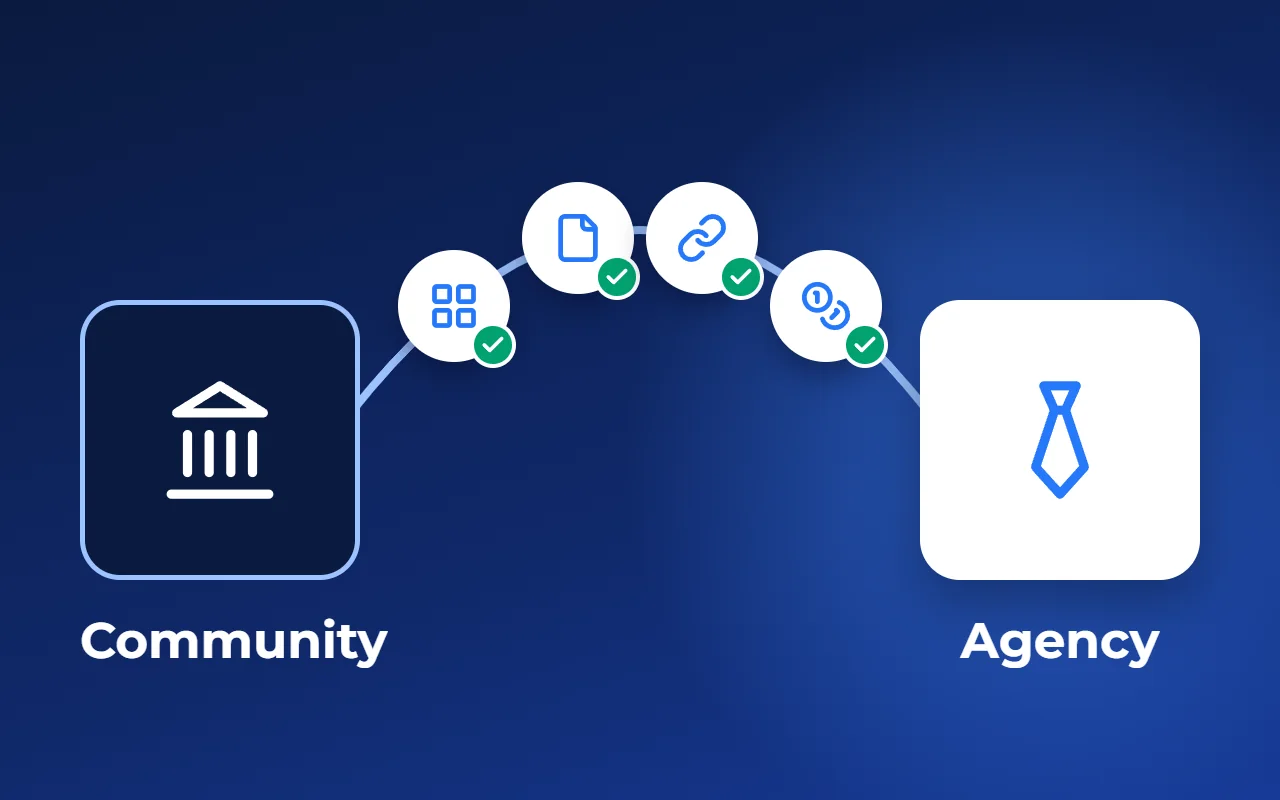
The agent claims a buyer in their dashboard or through a Telegram bot, and Smart plan checks whether the client is already registered to another agency. On the developer’s side, registrations land in the “Agency channel” pipeline: new, under review, confirmed and rejected, each with its end date. The responsible manager confirms or rejects a new registration right on its card. If two agencies bring the same client, the registration shows who was first, and the dispute is settled by the developer’s rules.
A confirmed buyer is handled as a lead in the main pipeline: the “Sources” tab shows that an agency brought them. The lead moves through the usual stages — meeting, reservation, contract. The agency’s card collects its registrations and sales.
A deal brought by an agency creates a commission. The “Commissions” tab shows the deal amount, the percentage and the agent’s amount, and the status shows where it stands: awaiting documents, ready to pay or paid. The “Partners” tab shows, for each agency, total sales, number of deals, how much has been paid and how much is left. The partner channel is enabled on request.
To see how it looks from the agent’s side, open the “For agencies” page — the link is below, under “Related solutions”.
Questions and answers
How long should a client registration protect the agent?
The developer chooses the period and writes it into the agency agreement, usually in days — for example, two weeks. Two things matter more than the number: the agent knows the end date at once, and only an event extends it — a viewing, a reservation or a financing application.
The buyer talks to several agents. Who gets the client?
The one who registered the client first, by date and time, provided the period has not ended. That is why the time must be recorded automatically — in a register, a form or a system — and the other agents told right away that the client is taken.
What if a registered buyer contacts the sales office directly?
Check the history. If the agent registered the client earlier and the period is still running, the client stays with the agent. If the client was in your database before the agent registered them, they are a direct client and the registration is declined — under a rule the agent knew in advance.
Why register by phone number rather than by name?
Names are written in many ways, and foreign names even more so. A phone number in international format is unambiguous and easy to search. Add email as a second identifier, and describe separately how you treat a spouse’s number or an investor’s representative.
Should registration rules be part of the agency agreement?
Yes. The agreement is the only thing you can point to in a dispute. Record the identifier, the period, the extension conditions, how direct clients are handled and who on the developer’s side makes the decision.